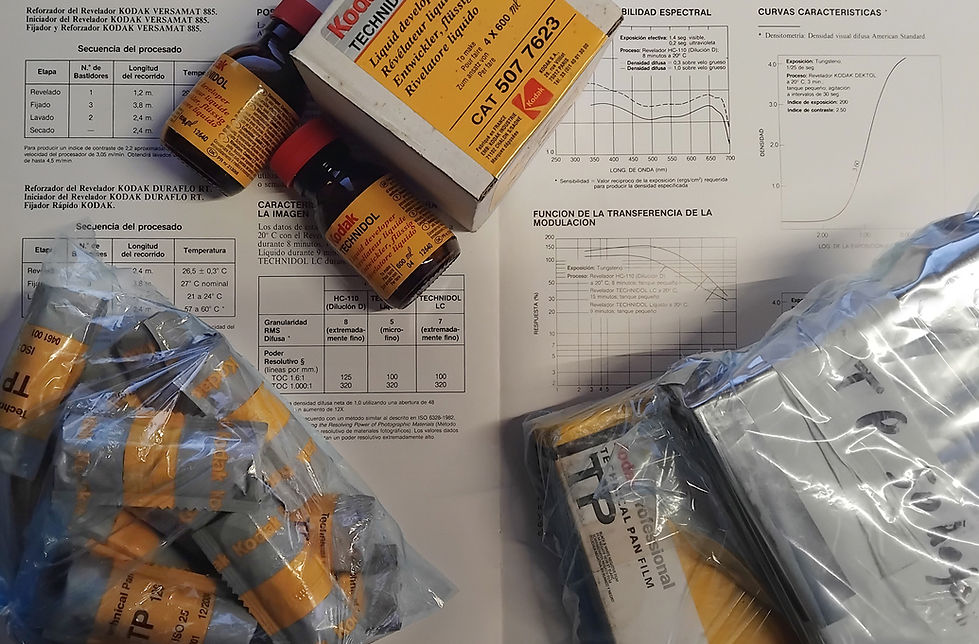
When photography loses one of its historical roles, preserving the past, and becomes a social tool for showing the present, Frozen proposes a reflection on what we have had, what we have dreamed of, what we no longer have, and what we can preserve or rescue from our ideals and our human relationships.
In the early 1980s, I received samples from Kodak of a new film, developed specifically for technical and scientific purposes. I conducted several experiments, and the image definition was the best I had ever seen, but the contrast was exaggerated, and even using ultra-compensating processes, I couldn't achieve the tonal richness I was looking for. Years later, Kodak developed a specific developer for pictorial applications with this film. Trying it put an end to my chemical experiments. Everything I had always sought in sharpness and tonal richness was there.
Probably, the Kodak scientists had developed their developer based on the same principles I had been experimenting with. Phenidone as developing agent, sodium sulfite as an antioxidant, and benzotriazole as an anti-fog agent, but their results were better than mine. That was a turning point in my relationship with photography and made me rethink what I was looking for in it, beyond technique and science.
When Kodak discontinued this film, I bought all rolls and plates available in stores in Barcelona. Knowing that at minus 20 Celsius the aging of black and white photographic emulsions stops, I left them in my freezer, as a relic waiting for a special occasion.
Although film cameras will continue to exist, I decided to build a camera myself to use these films, as a metaphor for the effort to preserve or rescue what we cherish.
A decade had passed when my friend, Manoel Morgado, and I decided to live out our long-held dream of a winter trek in the Himalayas, walking on the frozen Zanzkar River. In January, the riverbed freezes over, transforming it into the winter route used by the Zanzkaris for centuries. It was time to defrost the film, thaw the old dream, and almost freeze ourselves at thirty degrees below zero inside a narrow, shadowy Himalayan canyon. The film was intact, the dream still alive, the friendship still going strong.
But actually, the first time I took my relic out of the freezer was when my friend Pepe Font de Mora and I went on a bicycle trip through the Sahara. It was 2008; Pepe and I hadn't seen each other in a decade, but our friendship was alive and that old dream was bigger than ever. However, the only photograph I took on that trip was about the failure of a dream.
In 1988, during my long journey through the Sahara, I met a young Nigerian man on his way to Europe. The little he carried was his family's savings, invested in the dream that he would have a better life and one day be able to help them. Twenty years later, a tiny white dot on the sand caught our attention and we left our drawn straight compass line to check it... a human body, partially decomposed, lay eternally in that vast emptiness. Around him, there was no backpack, no bag, not even a simple water bottle... just a pair of shoes left a few meters behind. The last thing he had discarded. A deep feeling of sadness washed over me, at the thought that, in the absence of news, someone might be struggling between the feeling of having been forgotten or the pain of having lost a loved one.
How fortunate we are, that things and even dreams or friendships can be frozen in time and rescued again. But how small we are, knowing that life cannot be frozen. Perhaps, for that, some pretend to "freeze the moment", as they say in photography. I've never had that expectation.

Frozen nº 1. Platinum on cotton paper - 80 x 45 cm.

Frozen nº 2. Platinum on cotton paper - 80 x 45 cm.

Frozen nº 3. Platinum on cotton paper - 80 x 45 cm.

Frozen nº 4. Platinum on cotton paper - 80 x 45 cm.

Frozen nº 5. Platinum on cotton paper - 80 x 45 cm.

Frozen nº 6. Platinum on cotton paper - 80 x 45 cm.

Frozen nº 7. Platinum on cotton paper - 80 x 54 cm.

Frozen nº 8. Platinum on cotton paper - 80 x 45 cm.

Frozen nº 9. Platinum on cotton paper - 80 x 54 cm.
Frozen. Video 2 min.
Emptiness. Silver gelatin photograph on baryt paper and Saharan sand in a wooden box. 60 x 28 cm.