Things
We have accumulated knowledge, formulated theories, and found possible explanations for some of the fundamental questions. We have even created gods in our own image and likeness, but we still think and act homocentrically, believing that the entire universe, with its billions of galaxies made up of their billions or trillions of stars, circles around us. As if everything belonged to us, as if we could do anything with everything, as if we were the greatest thing.
But... above all, many things or few things is not a big deal. Something strange is that anything or something has something to do with an other thing. There’s nothing else to think, that’s life... kid’s stuff, grown-up stuff, and if not, well, on to something else. But, would you believe it! In something like a minute ago, I had never seen anything like this. Everything in its place; home things, the public thing, things we share... everything or few things. As if nothing happened, what a pointless thing... Don’t we have anything more important to do? It's a matter of patience, but that's a different thing. Craze thing! Oh, isn't that something! What a thing! What? What a weird idea! Well... that's my business.
Luiz Simoes, 2009
By Diana Gort - 10th Havana Biennial
Every story is contained within language*1, within the word; that which constructs for us an entire symbolic imaginary in which we exist: we do not create language, language creates us*2. We exist to the extent that we are named, to the extent that we construct, more fully and effectively, the space of narrative: time.
Babylon, with its brick buildings and temples that rose like unfinished pyramids*3, saw in a single language a first step toward world domination. One of its legends says that there the gods were frightened by the arrogance of men, who threatened them even in their celestial homes. And indeed, our relationship with the world has always been bipolar. Good-bad, ugly-beautiful, subject and object, us and the other, us and things.
Things. This is the title of the exhibition that Luiz Simoes presents at the 10th Havana Biennial. Born in Brazil and a naturalized Spanish, he abandoned his biology studies to pursue photography. He currently uses diverse techniques and works on conceptual projects that take years to conceive and realize, ultimately resulting in tangible objects.
Everything I do is a reflection on existence, on how fragile and irreversible everything is. This is my primary question and is present throughout my work*4. Things, moreover, is the fruit of the artist's years of travel and his commitment to understanding the world holistically, perhaps due to his scientific background*5. In this series of four pieces, Plasticosa, Electronicosa, Eve, Adam and Things, and What Thing?, the artist questions our relevance in the universe: we are so arrogant and anthropocentric that we create God in our own image and likeness*6.
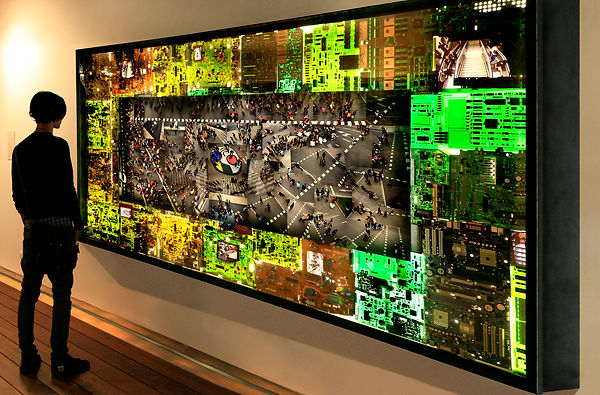
Things is a bird's-eye view, but one that includes himself, where Simoes sees us as small components of a great machine, as in the work Electronicosa. It is a narrative told through language, from a concept developed over years, of the history of humankind, which not only refers us to Babel as a metaphor for homocentrism but also to the Know thyself that the Oracle of Delphi told Aristotle or Gauguin's Who are we, where do we come from, and where are we going?
Things questions humanity, the human who is also a thing. From the moment we name ourselves, from the moment we ask ourselves who we are, where we come from, and where we are going, we are also an object, another thing among things. The human being, what thing?
1 - Alberto Abreu Arcia. The Games of Writing or the (Re)writing of History. Casa de las Américas Prize 2007, artistic-literary essay. Havana
2 - Martin Heidegger. Hölderlin and the Essence of Poetry. University of Havana
3 - Introduction to Exodus. Latin American Bible
4 - Luiz Simoes. Dossier Tempo
5 - Pepe Font de Mora. About Luiz Simoes
6 - Luiz Simoes. Interview during the 10th Havana Biennial


¿Qué cosa? (What?)
36 telephones that belonged to a police station, 36 images stolen on the streets with a phone and mounted on plexiglass, acrylic ink, voice and electronic circuitry, in a oxidized iron box. 14x95x185 cm

Electronicosa
Duratrans on Plexiglas over electronic circuit boards in light box. 21x120x234 cm

Plasticosa
Duratrans on plexiglass over my plastic waste from a year and acrylic paint in a light box. 13x90x234 cm

Eve, Adam and Things
Video of a choreographed dance with music for Basuróphonos, female vocals, a handsaw, and percussion, on a 32-inch screen with a oxidizaed iron frame. 10 minutes on a loop. 13x90x120 cm
Making of Eva Adán y las cosas - video 2 min.

Dialogue between spermatozoa and egg
Musical performance for balloon with microphone, 2 string instruments and pre-recorded voices. 5:15 min.
Intruder Zone. Things
Curated by Andrea Aguado
The Zona intrusa project aims to bring contemporary art closer to the educational community, through works by guest artists created in collaboration with students from various schools.
The project's curator, Andrea Aguado, wanted to explore the world of things, the objects that surround us, arguing that today we have forgotten how to engage with them because, mesmerized by screens and the universe of information and communication, we no longer see things and have simply found a way to assimilate them.


Things are just things and there are things in life that aren't just things, things I wouldn't trade for anything.
Front: Silver gelatin print on canvas / Back: Polyurethane, iron pigments, and broken bicycle frame. 90x146 cm

Kid's stuff
Toy guns, polyurethane, iron oxide and hydroxide on canvas. 90x146x19 cm

Banana gelatin on plate urine toned
Silver gelatin on paper gold toned. 49x59 cm
Tenth Havana Biennial, 2009


Blanca Berlin Gallery. Madrid, 2008


Making of Las cosas - video 2 min.