VERTIDOS
VERTER:
From the Latin vertěre - To spill, to throw
VESTIR:
From the Latin vestīre - Protect or adorn the body
I remember when I was at university in Rio, a graffiti on a wall said:
Fighting is useless, the Sun will burn out in 6 billion years.
On the same wall someone painted:
What a relief! I thought it would be in 6 million.
In nature, everything has always happened on a non-human timescale. It's true that one day the sun will stop shining, that life on our planet has an expiration date, but we are accelerating it, making it a visible process. In the last hundred years, we have burned more natural reserves than in four billion years of organic activity on the planet.
Can we allow history to keep slowly?
Luiz Simoes, 2004
The Vertidos

aluminum, cardboard, plastic, tetra pak and glass. 2004/2005
Everything has cycles. The stories we imagine have cycles; we have cycles, and within our cycles, we imagine and create in different ways.
In 2004, when the idea for VERTIDOS came to me, my thoughts were dominated by the vision of how beautiful we are, capable of creating beauty even in situations of hardship and scarcity. At the same time, I also wanted to reflect on our destructive capacity, so contrasting and inconsistent with our intellectual capacity.
In the following years, different cycles led me to other visions. A second series of photographs emerged, in which exhausted and soiled bodies, adorned with our creations, lie on the earth.
Years later I created a series of object-based paintings with those same dresses, in which the bodies are no longer present, and only the remnants of our creations remain. Today, twenty years later, in my current cycle, I'm starting a new series of works using the dust from those same five materials, aluminum, , cardboard, plastic, Tetra Pak and glass, and the question I asked myself in 1988, during my solitary crossing of the Sahara, returns to my mind:
One hundred thousand? One million? How long would it take for everything we've built to collapse and for the earth and weeds to cover everything, forever erasing every trace of our fleeting presence on the planet?
And my question today remains the same:
Can we allow history to keep slowly?
Luiz Simoes, 2024

aluminum, cardboard, plastic, tetra pak and glass, 2007
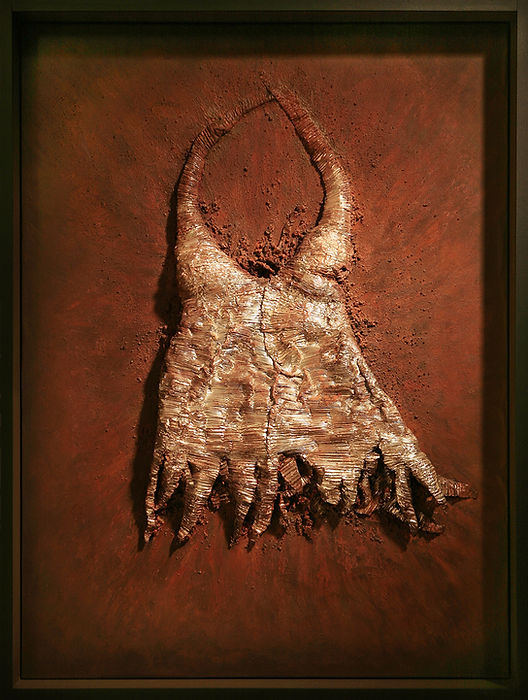
Aluminium Vertido
Acrylic, iron pigments, polyurethane and aluminium dress on canvas in display case 100x130x10 cm

Plastic Vertido
Acrylic, iron pigments, polyurethane and plastic dress on canvas in display case 100x130x10 cm

Tetra pak Vertido
Acrylic, iron pigments, polyurethane and tetra pak dress on canvas in display case 100x130x10 cm

Cardboard Vertido
Acrylic, iron pigments, polyurethane and cardboard dress on canvas in display case 100x130x10 cm

Glass Vertido
Acrylic, iron pigments, polyurethane and glass dress on canvas in display case 100x130x10 cm
Dust

Glass Dust
Acrylic, iron pigments, resin, and glass powder on canvas in a display case, 100x130x5 cm
In progress
Aluminum Dust, Plastic Dust, Tetra Pak Dust, Cardboard Dust
Electronic Dust, Metallic Dust
The objects
In the poem "Adventure," the main character is a pot that the poet Manoel de Barros finds lying upside down and empty in a remote place. In this state of abandonment, the pot contained nothing but emptiness.
Not long ago, this vessel must have been the center of attention, attracting the desire of those who wanted it close because of what was inside. Perhaps it received admiring glances because it contained something that awakened immediate pleasure. I imagine that this pot, now empty and abandoned in the forest, may once have been a container of sweets or ice cream. Occupying the center of the table, it received eager looks.
When desired, the pot may have been mistaken in imagining that it was wanted for what it was and not for what it temporarily contained. Immense will be its sorrow now, abandoned. Rejected by humans and their fickle desires, only nature wants it. Nature never despises; rather, it receives, regenerates, and fills voids. Spinoza already knew this.
Useless, the can was no longer of any use, except for metamorphosis, for that is what nature produces in everything that, receiving its care, undergoes a kind of contagion, a communion. "After dissolving in nature, cans can even enchant butterflies," the poet foresaw.
Some time later, the writer had to return to the same remote place. He remembered the empty, abandoned can and prepared to see that sad sight again. However, during the intervening time, without the poet's knowledge, a little bird flew, by chance, over the can and left a seed in its empty womb. There was already sand and dust inside, deposited by nature. The rains and the winds gave the vessel's pregnancy the strength to give birth, and where there had been emptiness before, a living poem emerged. From that womb, a rosebush bloomed...
"If we don't give our love, it rots inside us," the poet said, thanking the can for this lesson he received in the form of roses. Because the vessel was now filled with the beauty that nature offers us without asking anything in return.
Elton Luiz Leite de Souza
Philosopher. Professor at the Federal University of Rio de Janeiro

The TV
Pigment ink print and acrylic varnish on canvas. 100x130 cm

A couple of chairs
Pigment ink print and acrylic varnish on canvas. 100x130 cm
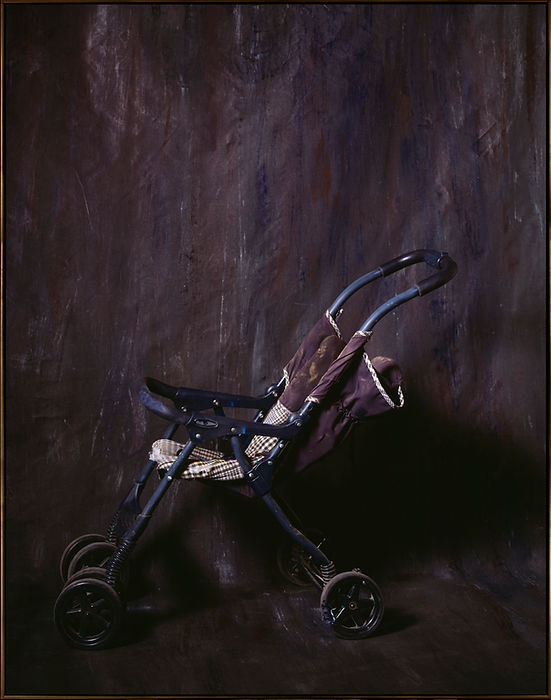
The stroller
Pigment ink print and acrylic varnish on canvas. 100x130 cm

Coat
Pigment ink print and acrylic varnish on canvas. 100x130 cm

The motorcycle
Pigment ink print and acrylic varnish on canvas. 100x130 cm
The void

Earth
Acrylic on canvas. 130x400cm

Darkness
Acrylic on canvas. 130x400cm

Expansion
Acrylic, pigments and metallic powder on linen. 130x200 cm

Void
Acrylic on canvas. 130x200cm

Absence
Acrylic on canvas. 130x200cm
Requiem for 2 Basuróphonos

The work is based on the idea that, in a decadent and exhausted future, where the only resources are remnants of richer times, a character who has never seen a musical instrument would build, by intuition and with scarce resources, two instruments similar to a cello and a double bass, with which to musically express his lament with the dire situation in which he finds himself.
The music is inspired by the continuous noise of the garbage truck accelerating its engine. Reproducing the sounds with my voice, I recorded several fragments and editing the takes in a time line, I created the whole sequence. It was the way I found to write my music without being a musician. The sequence, in its original form, was later performed by the cellist Ivan Lorenzana using the instruments built of rubbish, “basura” in Spanish, hence their names “basuróphonos”. “Requiem for two Basuróphonos”, is a lament, a dialogue between the two instruments, that turns around itself in a piece that brings to mind what we are doing… accelerating.

Requiem for 2 Basuróphonos
Audiovisual installation for three slide projectors digitally controlled. 7 minutes
Musitekton - Barcelona, 24 de marzo de 2012
Iván Lorenzana - Basuróphono mezzo
Ernesto Vargas - Basuróphno basso
Interview Requiem for 2 Basuróphonos - video 4 minutes
Making of Vertidos, Plastic and Aluminum - 4 minute video
Making of Absence - 4-minute video

Brasilea Foundation. Basel, 2006

Galería Blanca Berlin. Madrid, 2008

Centro Cultural Puertas de Castilla. Murcia, 2009
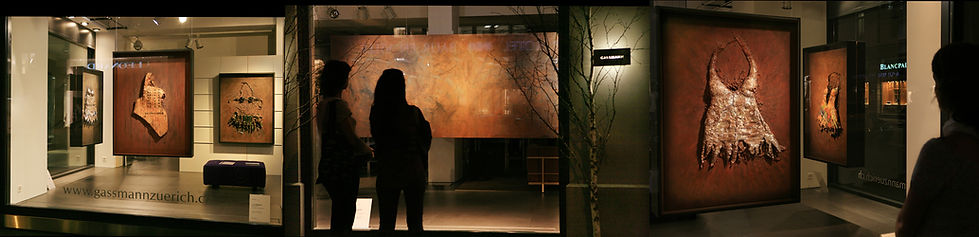
Gassmann Zürich, 2011